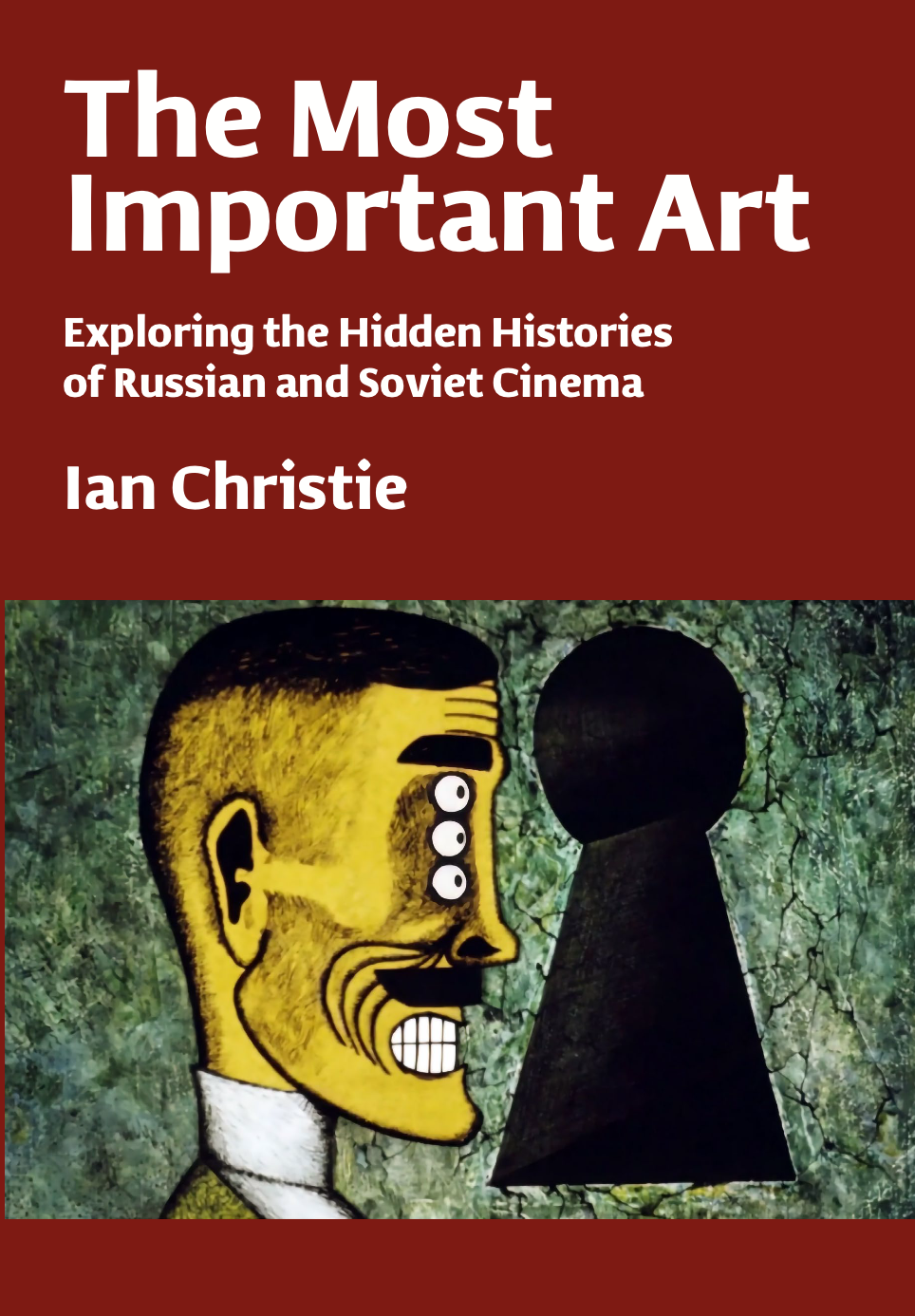
Cinema was officially the USSR’s ‘most important art’ because Lenin had said it could be and the Soviet avant-garde became international ambassadors for the new regime. But Russians loved movies for a decade before the Bolsheviks seized power, and had already created poignant masterpieces which would only be rediscovered during perestroika. Meanwhile, a new generation of Soviet filmmakers and critics spearheaded Gorbachev’s reforms, giving early warning of the dramatic changes ahead. Witnessing Soviet cinema’s final tumultuous decade first-hand, Ian Christie befriended its leading figures, getting their films shown abroad and exploring their diverse roots in the writings collected here, which bear witness to the continuing importance of Russian cinema—much of it long hidden by censorship and prejudice—irrespective of who occupies the Kremlin.
Here for the table of contents.
Ian Christie is one of the true pioneers of the study of Russian and Soviet cinema. This rich collection showcases the range and importance of his contributions, and their legacy for the field today. It will reward both specialist and non-specialist readers.
Emma Widdis, University of Cambridge
Cinema triumphs as the ‘most important art’ in this spectacular collection, a testament to Ian Christie’s lifetime dedication to the best and the brightest in the Soviet film tradition. He has persevered in studying it since the 1970s, inspired by researchers such as Jay Leyda and Maya Turovskaya. Diverse and richly illustrated, the essays feature the work of cineastes from different persuasions and generations, Eisenstein and Trauberg and Sokurov, but also those working at the empire’s periphery—Muratova (Odessa), Parajanov (Kyiv/Tbilisi), Peleshian (Yerevan). Other aspects of the film process—institutions, documentary, animation—are also in focus. A volume that sends an open invitation to those who want to continue the work. I loved it.
Dina Iordanova, University of St Andrews
Christie’s approach to Russian, Soviet and post-Soviet cinema challenges the canon. We learn about the protean Protazanov, a filmmaker whose very ability to change genres, countries, political philosophies makes his oeuvre hard to isolate and chart. We learn a lot about the breathtaking adventures of Kozintsev and Trauberg’s Oktyabrina, super-heroine of a Soviet eccentric slapstick long since lost. And about miracle movies by Boris Barnet. Clio is a forgetful muse—saving people and pictures from historical oblivion is Ian Christie’s most important skill.
Yuri Tsivian, University of Chicago
lan Christie, known for his books on Scorsese and Powell & Pressburger, is Professor of Film and Media History at Birkbeck, University of London, a Fellow of the British Academy and Visiting Tutor at the UK’s National Film and Television School. He has been programming and interpreting Russian and Soviet cinema through many regime changes, in retrospectives, television programmes, exhibitions and books, including the Film Factory anthology (1988), co-edited with Richard Taylor. Recently, he has co-directed two films, A Trip to Tetlapayac (2023) and Voices from the Chorus (2026), reflecting on what we make of the Soviet legacy today. His website is here. His collection of essays about early cinema, published by Sticking Place Books, is here.