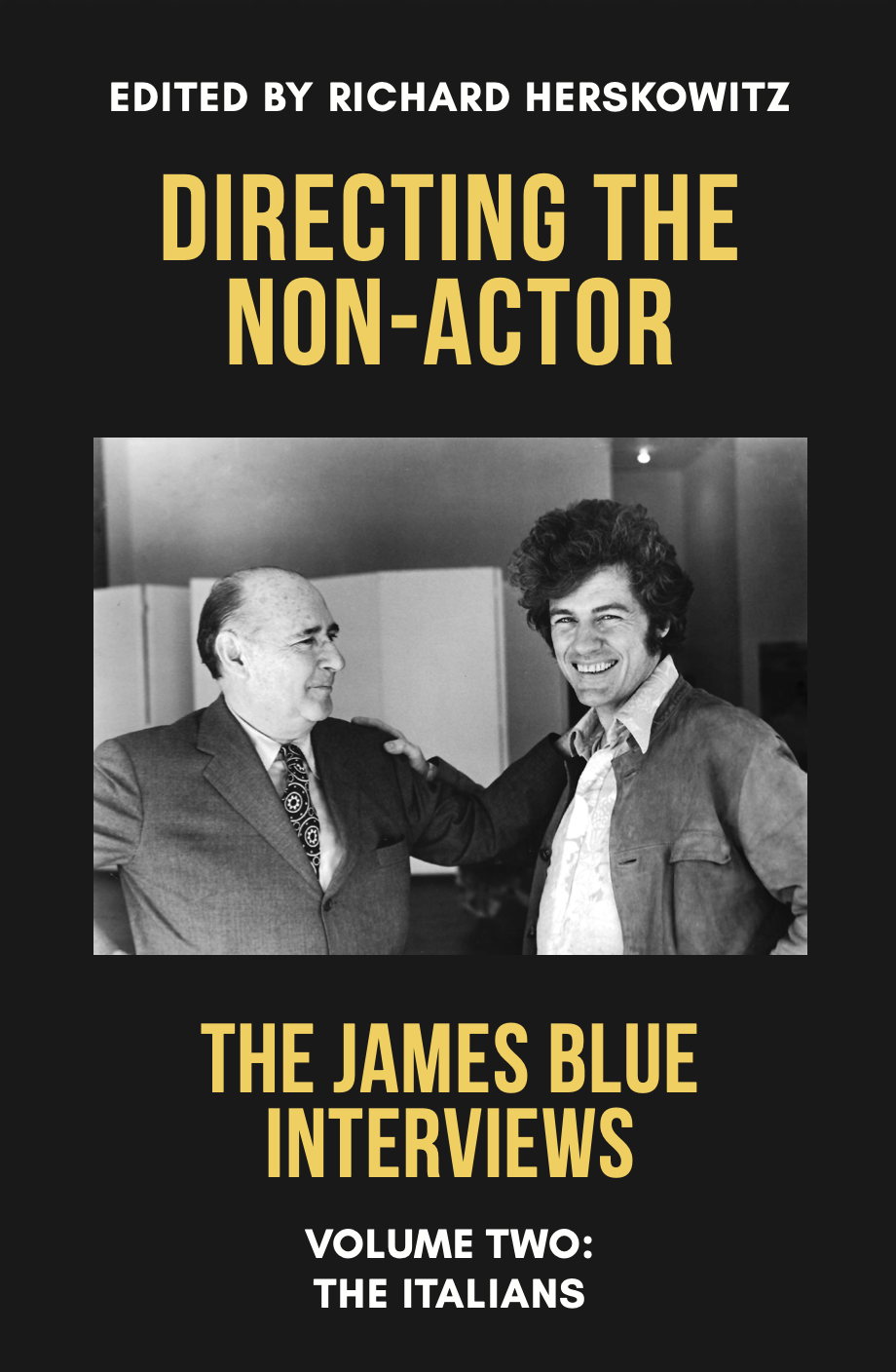
Directing the Non-Actor
The James Blue Interviews, Volume Two: The Italians
Edited by Richard Herskowitz
In September 1965, American filmmaker James Blue arrived in Venice and Rome on a mission: to learn the secrets of directing non-actors from the masters of Italian cinema. Sponsored by the Ford Foundation, Blue secured rare, candid conversations with the greatest directors of the neorealist movement and its heirs—from Roberto Rossellini and Vittorio De Sica to Federico Fellini, Pier Paolo Pasolini, and Bernardo Bertolucci. Together, they explore improvisation and instinct, the power of the untrained face, and the revolutionary idea that anyone—given the right director—can come alive on screen.
Volume Two of Directing the Non-Actor is an indispensable document of a golden era in world cinema. The book opens with the revelatory, behind-the-scenes orientation to neorealism’s origins, achievements, and aftermath conducted for Blue early in his visit by the well-connected screenwriter and critic Tullio Kezich.
Film directors and screenwriters Interviewed: Bernardo Bertolucci, Renato Castellani, Gianfranco De Bosio, Vittorio De Seta, Vittorio De Sica, Federico Fellini, Tullio Kezich, Ermanno Olmi, Pier Paolo Pasolini, Francesco Rosi, Roberto Rossellini and Cesare Zavattini.
Richard Herskowitz's collections of the James Blue interviews with directors have a permanent value. The emphasis throughout is on various forms of realism in film performance, a topic that has never been given the attention it deserves and from which there is much to learn. The conversations are filled with insights--this is essential reading for directors, actors, and cinephiles.
—James Naremore, author of Acting in the Cinema
James Blue (1930–1980) was a groundbreaking filmmaker, educator, and advocate for public, accessible media. Born in Oklahoma, he studied at the University of Oregon before earning a scholarship to Paris’s prestigious IDHEC, where his classmates included Costa-Gavras and Johan van der Keuken. His debut feature, Les Oliviers de la Justice, received the Critics’ Prize at the 1962 Cannes Film Festival. His USIA documentary The March (1963–64), documenting the Civil Rights March on Washington, was later added to the National Film Registry. A Few Notes on Our Food Problem (1968) earned him an Academy Award nomination. As an educator, Blue taught at UCLA, the American Film Institute, Rice University, and SUNY Buffalo, where his students included Paul Schrader, Joan Churchill, and Jim Morrison. With initial support from a Ford Foundation grant, he conducted and recorded over 75 interviews with major international filmmakers, considered one of the most important film history archives of the 20th century. He died of cancer in 1980, just before turning 50.
Richard Herskowitz is a media arts curator and administrator who has served as director of Cornell Cinema, the Ashland Independent Film Festival, Virginia Film Festival, and Houston Cinema Arts Festival. He has been a programmer multiple times and president of the board of the Robert Flaherty Film Seminar as well as chair of its 50th Anniversary Committee. He has taught film studies and curated media art museum exhibitions at University of Virginia, Cornell, and the University of Oregon, and has written extensively on film and other cultural subjects in Social Text, Wide Angle, and other publications. He leads the James Blue Project, affiliated with the University of Oregon Libraries’ James Blue Archive, and oversees its website at jamesblue.uoregon.edu.
Soon